Have you ever asked yourself how Google works? The life span of a Google query normally lasts less than half a second, yet involves a number of different steps that must be completed before results can be delivered to a person seeking information. This infographic below provides a good overview what happens when creating content on the worldwide web until the results are being displayed on your web browser, after sending a Google query.
The official statement from Google is:
The software behind our search technology conducts a series of simultaneous calculations requiring only a fraction of a second. Traditional search engines rely heavily on how often a word appears on a web page. We use more than 200 signals, including our patented PageRank™ algorithm, to examine the entire link structure of the web and determine which pages are most important. We then conduct hypertext-matching analysis to determine which pages are relevant to the specific search being conducted. By combining overall importance and query-specific relevance, we’re able to put the most relevant and reliable results first.
PageRank also considers the importance of each page that casts a vote, as votes from some pages are considered to have greater value, thus giving the linked page greater value. We have always taken a pragmatic approach to help improve search quality and create useful products, and our technology uses the collective intelligence of the web to determine a page’s importance.
- PageRank Technology: PageRank reflects our view of the importance of web pages by considering more than 500 million variables and 2 billion terms. Pages that we believe are important pages receive a higher PageRank and are more likely to appear at the top of the search results.
- Hypertext-Matching Analysis: Our search engine also analyzes page content. However, instead of simply scanning for page-based text (which can be manipulated by site publishers through meta-tags), our technology analyzes the full content of a page and factors in fonts, subdivisions and the precise location of each word. We also analyze the content of neighboring web pages to ensure the results returned are the most relevant to a user’s query.
Bytheway, did you know that Google processes almost 20PB of data daily? 20PB (Petabytes) = 20,971,520 GB (Gigabytes)
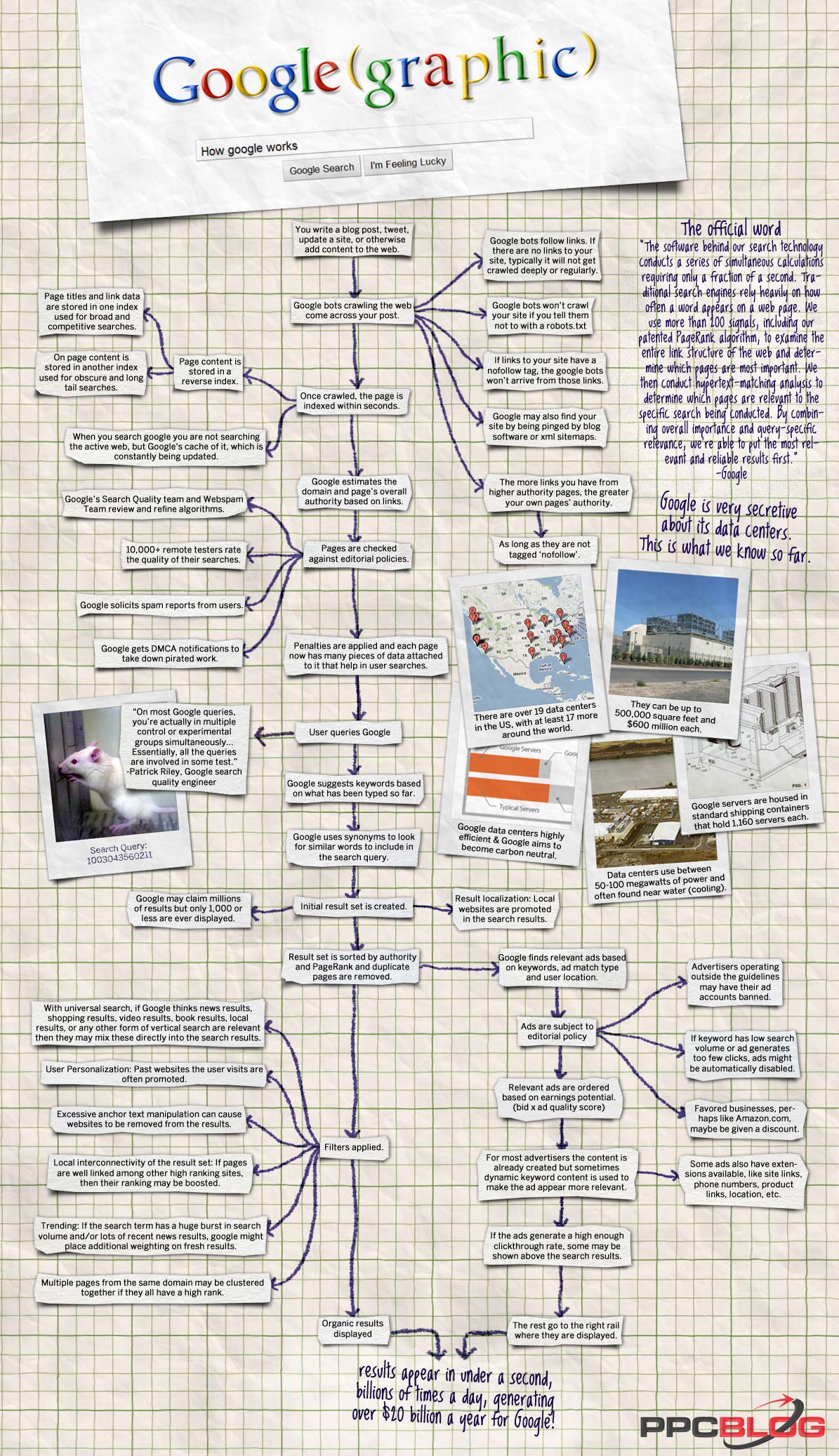
Click on the picture to enlarge it
Comments Closed